Talk & Connect: Everyday Conversations With Your Child
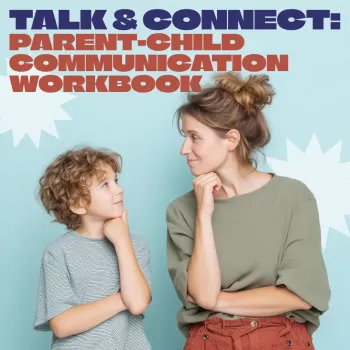
A stronger connection with your child can begin in an ordinary moment: a question over breakfast, a walk around the block, or a few minutes together after school. Our Talk & Connect parent-child communication workbook offers conversation starters and a positive-parenting focus for families who want to make those moments more intentional. It can help you begin. The connection itself grows when you keep showing up, listening, and making room for your child’s point of view.
Start with a moment that already belongs to your family
You do not need to arrange a perfect heart-to-heart. Choose a routine you already share, such as a meal, a drive, bedtime, or time spent walking together. A familiar setting can make a question feel less like an announcement and more like part of your day.
Start with one open-ended question, then leave enough quiet for your child to consider it. You might ask, “What was the most interesting part of today?” If the answer is brief, silly, or about something you did not expect, that still counts as participation. You can follow their lead instead of trying to turn every answer into a deeper discussion.
Sharing a little about your own day can help the exchange feel mutual: “I had to try something new today, and I felt nervous at first.” Then bring the attention back to your child. The goal is a conversation, not a report from either of you.
Choose questions that invite, rather than test
Some everyday questions are easy to answer with “fine” or “yes.” Others can sound as though there is a correct response. A small change in wording gives your child more choice about what to share. These sample prompts are ideas you can try, not quoted pages from our workbook.
| Instead of asking | Try asking | What it makes room for |
|---|---|---|
| “Was school good?” | “What’s one moment from today you’d like to tell me about?” | A story your child chooses |
| “Why are you upset?” | “Do you want to tell me what happened, or would you like some quiet first?” | Feelings and a choice about timing |
| “Did you finish everything?” | “What felt easy today, and what felt tricky?” | Honest reflection without an immediate verdict |
You can also invite shared problem-solving without taking over: “What have you tried so far?” or “Would you like ideas, or would you rather I listen?” The best opening is one that fits your child and the moment. If a question lands awkwardly, you can simply try a different approach another day.
Listen before moving into solutions
When your child tells you something difficult, it is natural to want to fix it. Try pausing first. Reflect back the part you heard—“You were looking forward to that plan, and it changed”—and ask whether you understood. Your child may add a detail that changes what kind of support they want.
Acknowledging a feeling does not mean agreeing with every behavior or changing a family boundary. You can hold both: “That sounds disappointing. Do you want me to listen, or would it help to think through what to do next?” You are recognizing the experience while leaving room to address what happened.
The Harvard Center on the Developing Child describes the value of responsive back-and-forth interactions between children and caring adults. The CDC’s positive parenting tips also offer age-based guidance for supporting children as they grow. Neither resource asks you to make every exchange a breakthrough. An attentive response to a small story matters, too.
Let connection grow at your child’s pace
Adapt your questions to your child’s age, interests, and willingness to talk. A younger child might enjoy describing an imaginary character’s day. An older child might prefer to discuss a game, a friendship, or a decision they are weighing. Some children talk more comfortably while drawing, cooking, or doing another activity alongside you, when eye contact and conversation are not the only focus.
If your child says they do not want to talk, respect that answer. You can say, “Okay. I’m here if you want to tell me later,” and give them room. Keeping the door open is different from asking the same question again until you get a response.
We made Talk & Connect a guide you can return to when you want a fresh opening, not a script you must follow word for word. Use a question as a starting point, change its language to sound like your family, or set it aside when listening is the better choice.
Keep the habit small enough to repeat
Other tools may support your own routine, but they serve different purposes. If writing down a simple intention helps you remember to make time, our Goal-Setting Guide for Real Results is a printable planning option. For the conversations themselves, explore our Talk & Connect workbook: a parent-child communication guide centered on conversation starters, positive parenting, and emotional connection. Start where your family is, and let the habit grow through repeated, attentive exchanges.
FAQ
What is parent connect?
Parent-child connection is the sense that your child can be heard, understood, and supported by you or another caregiver. Talk & Connect is the name of our communication workbook, not a separate parenting program.
What if my child does not want to talk?
Respect their answer, let them know you are available, and try another low-pressure moment later. No question works for every child or every day.
Do we need a long conversation every day?
No. Brief, attentive exchanges are a manageable place to start. Focus on listening and making regular opportunities to talk rather than meeting a fixed conversation length.







Leave a comment