Easier Homework Evenings: A Parent’s Guide
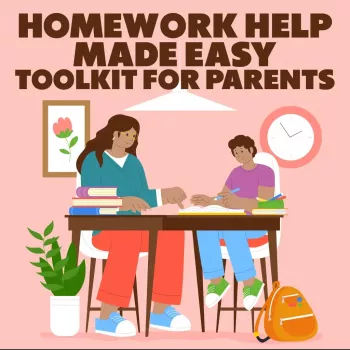
Homework can turn a busy evening into a negotiation: When will you start? Where did the directions go? How much help is too much? A simple routine and a clear first step can make those questions easier to handle. Our Homework Help Made Easy Toolkit for Parents is a printable guide focused on study habits, homework strategies, and independent learning. Here’s how you can put those ideas to work without taking over your child’s assignments.
Start with a routine your family can repeat
Choose a homework start time that fits both your child’s energy and your household schedule. Some children benefit from a short break and a snack after school; others would rather begin while the school day is fresh in their minds. The best time is one you can usually follow, not one that looks perfect on paper.
Give homework a consistent place, too. It does not need to be a dedicated desk. A cleared section of the kitchen table can work if your child has room for the assignment and commonly used supplies are nearby. Reduce distractions where practical, but make the plan fit your home rather than expecting a silent evening.
Try the routine for a week, then ask your child what helped and what got in the way. If activities or family schedules change, adjust the plan together. Treating the first version as a trial gives your child a chance to help shape a routine they can actually use.
Make the first step small
“Do your homework” can feel like a large, vague instruction. A brief check-in makes the work more concrete: name each assignment, identify what is due first, and choose one action to begin. That action might be reading the directions aloud, gathering materials, writing a heading, or completing the first problem.
You can help organize the work while leaving the thinking to your child. If an assignment has several parts, ask, “Which part will you try first?” rather than walking through every answer. A small start does not solve the whole evening, but it gives your child something manageable to do next.
| Moment | Parent prompt | Child’s next step |
|---|---|---|
| Before starting | What needs to be done today? | List assignments and choose where to begin. |
| When stuck | What have you tried so far? | Explain the problem and try another approach. |
| Before finishing | How will you check your work? | Review the directions and completed assignment. |
Help without becoming the homework manager
Your role is to provide structure, encouragement, and a sounding board—not to supply answers. You might help your child find the assignment instructions or talk through what a question is asking. Then give them room to attempt the work. When they ask whether an answer is right, try asking how they reached it before you respond.
Limited choices can make independence less intimidating. Ask whether your child wants to start with reading or math, or whether they would prefer to work at the table or another suitable spot. Both options move homework forward, while your child practices making a decision.
As the routine becomes familiar, step back gradually. At first, you may sit together to review the assignment list. Later, your child might make the list independently and call you over only for a short check-in. Eventually, they may be ready to review their own work against the directions before saying they are done. Progress does not have to be perfectly steady; a difficult assignment may call for more support than yesterday’s did.
Our printable toolkit offers a dedicated place to begin working on these habits. If you also want a separate resource for organizing your own priorities, our Goal-Setting Guide for Real Results is a printable planner. It is a broader planning resource, not a substitute for your child’s homework routine or their teacher’s instructions.
Know when a different kind of help is needed
Occasional frustration is part of learning. Repeated confusion, though, or homework that regularly takes much longer than expected deserves attention. Ask your child which directions or concepts are causing trouble, and note whether the same issue keeps coming up. You do not need to diagnose the problem yourself.
If your child consistently cannot complete the work independently, contact the teacher. Ask what the assignment is meant to practice, how long it is expected to take, and what support is available when your child gets stuck. That conversation can help you distinguish between a routine that needs adjusting and work that needs more explanation.
A workable routine does not guarantee a perfectly calm evening. The goal is to give your child a predictable way to begin, a reasonable way to ask for help, and increasing ownership of the work. For more general guidance on supporting children as they grow, you can explore the CDC’s Positive Parenting Tips.
Keep the plan easy to revisit
Homework changes as assignments, activities, and your child’s independence change. Revisit your plan when the current start time stops working or your child is ready to handle another step alone. Keep the conversation practical: What should stay? What should change this week?
FAQ
Who helps you do homework?
A parent or caregiver can help set up a routine, clarify directions, and ask useful questions. A teacher can help when instructions or concepts remain unclear. Your child should do the assignment’s thinking and work.
How can parents encourage independent homework habits?
Start with a consistent routine and a brief check-in. Let your child choose a starting task, try it independently, and review the finished work before asking for help.







Leave a comment